


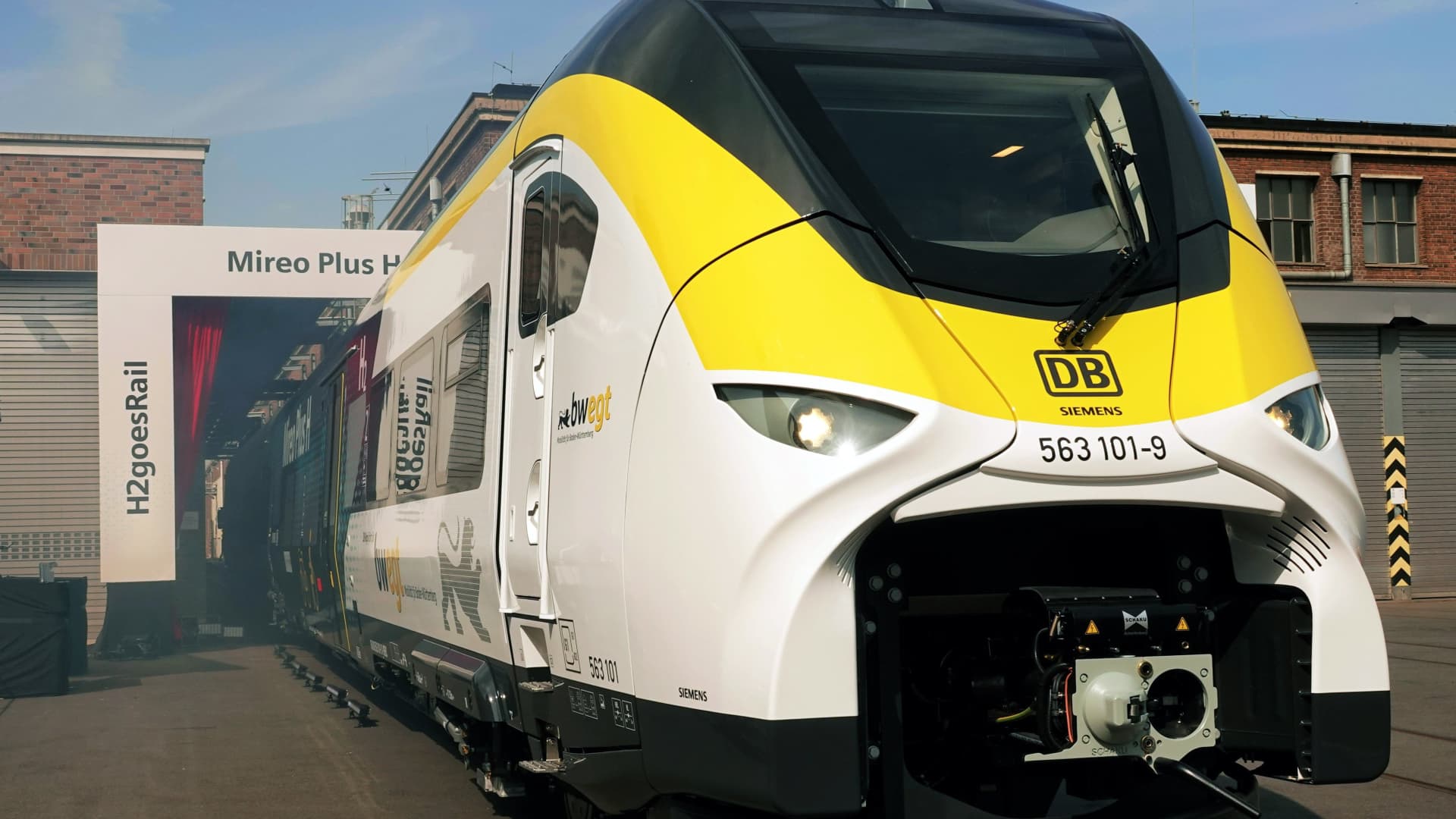
A Mireo Plus H train photographed in North Rhine-Westphalia, Germany, on May 5, 2022. According to Siemens Mobility, the train can hit a top speed of 160 kilometers per hour, or around 99 mph.
Sophie Brössler | Picture Alliance | Getty Images
Siemens Mobility is to build several hydrogen-powered trains for a network in the Berlin-Brandenburg metropolitan region of Germany, in the latest example of how hydrogen-based technology is being used in rail transport.
In a statement Monday, Siemens Mobility said it had been commissioned by rail operator Niederbarnimer Eisenbahn to provide seven of its Mireo Plus H trains. The two-carriage vehicles will use fuel cells and lithium ion batteries, and are slated to be delivered in the fall of 2024.
Operations on the Heidekrautbahn network are planned to start in Dec. 2024. In addition, the order includes a 10-year service and spare parts contract that runs until 2034.
Siemens Mobility, which is a separately managed company of industrial giant Siemens, said the trains would provide “completely CO2 emission-free mobility” and have a top speed of 160 kilometers per hour (around 99 mph).
The firm has previously said the Mireo Plus H’s range comes in at between 600 and 1,000 kilometers. “By switching from diesel to hydrogen, Heidekrautbahn will reduce its annual CO2 emissions by around three million kilos and save 1.1 million liters of diesel,” the company said Monday.
The deployment of hydrogen-powered trains on the network is part of a joint pilot project that’s being funded by the states of Berlin and Brandenburg as well as the federal government.
Described by the International Energy Agency as a “versatile energy carrier,” hydrogen has a diverse range of applications and can be used in a wide range of industries, including transportation.
According to the IEA, rail represents “one of the most energy-efficient transport modes.” It is responsible for 9% of worldwide motorized passenger movement and 7% of freight, the IEA says, but only accounts for 3% of transport energy use.
It does, however, rely heavily on oil, which represented 55% of the sector’s total energy consumption in 2020. Under the IEA’s scenario for a net-zero energy system by the year 2050, oil use in rail would have to drop to “almost zero” by the middle of the century.
Siemens Mobility is one of several companies that have been working on trains that use hydrogen. Others include East Japan Railway and European railway manufacturer Alstom. The latter has already carried passengers in Germany and Austria on hydrogen trains.
